Growing with Children
Gardening with Children
A practical start to gardening with children: planning a small plot, tools that fit small hands, sowing the first seeds and keeping the work short and regular.
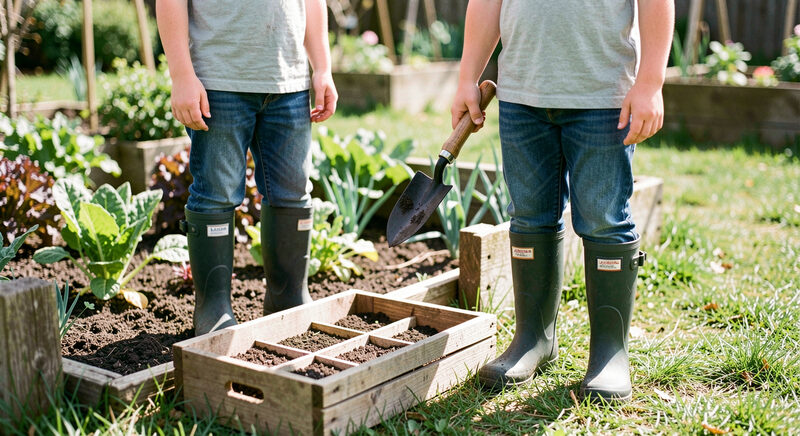
Gardening with children works best when the plan is small, the tools fit the hand, and the first results arrive quickly. A child who sows a radish seed and pulls a red root three weeks later learns more about how plants work than a whole afternoon of explanation. The aim of this guide is to get a family from an empty corner of ground to a first harvest without buying much and without turning the job into a chore.
Start with a patch the size of a door
A bed about one metre by two is enough for a first year, and it can be smaller. A raised timber box, a couple of large pots, or a strip of ground beside a wall all do the same job. What matters is that a child can reach across the bed without standing on it, so keep the width under about 90 centimetres, or make a bed that can be reached from both sides.
Choose the sunniest spot available. Most vegetables want six hours of direct light a day, and a patch that sits in shade until noon will grow leaves but very little fruit. If the only space is a balcony, that is not a problem: the guide to growing vegetables in containers covers pots, compost and the crops that stay small enough for a windowsill.
Tools that fit small hands
Children do not need much. A hand trowel, a small fork, a watering can they can carry when full, and a pair of gloves are enough to begin. Look for tools with a wooden handle and a metal head, sized for a five to eight year old, rather than the plastic sets sold as toys: a real trowel lasts years and cuts into soil instead of bending. Keep a full-size fork and spade for the adult work of breaking up ground and digging in compost, and let children join that part with their own tools rather than the heavy ones.
A few trays and small pots are useful for raising seedlings on a windowsill before planting out. Save the plastic trays that fruit comes in, punch a few holes in the base, and they will do. An old spoon makes a fine measuring scoop for seed compost.
Prepare the ground together
If the patch has been grass or bare soil, the first job is to clear it and open it up. Spread a layer of garden compost or well rotted manure over the surface and let children help fork it in. They will enjoy finding worms, and a worm is worth a sentence or two about how soil is alive. Do not worry about making the tilth perfect: vegetables are more forgiving than a show garden, and a slightly rough bed is easier for small plants to settle into than a fine, dusty one.
If the soil is heavy clay or thin and stony, build the bed up with bought topsoil and compost instead of fighting what is there. A raised box filled with a mix of soil and compost is the simplest reliable start for a family garden, and it saves backs as well as patience.
Choose crops that reward patience
The best first crops are quick, obvious and hard to kill. Radishes, lettuce, peas, runner beans, courgettes and potatoes all fit that description, and each one gives a child something to look at within days. The guide to easy vegetables for children to grow sets out ten of them with sowing times, spacing and what the harvest looks like.
It helps to grow one thing that comes up fast, one thing that is tall enough to be interesting, and one thing that can be eaten straight from the plant. A row of radishes, a wigwam of climbing beans and a couple of strawberry plants cover all three, and they keep a child coming back to the bed through the season.
Sow with a child, not for one
Show the depth on a finger rather than a ruler. Radish and lettuce seed goes about one centimetre deep, bean seed about five. Let the child make the drill with a stick, drop the seed in, and cover it. Thin spacing by eye and do not fuss: it is easier to pull out extra seedlings later than to explain why a seed needs room.
Watering is the job children take to most readily, and the one that teaches the most. A gentle can with a rose is better than a hose, because it does not wash the seed out or flatten young plants. In summer, a morning watering does more good than an evening one, and a finger pushed into the soil is a better test than a glance at the surface.
Keep the routine short
Ten minutes twice a week beats an hour once a month. A short, regular visit keeps weeds down, spots problems early and keeps the garden part of the week rather than a project that finishes. Let the child own one small task, such as filling the bird bath or checking the bean stems for flowers, so the garden is theirs as well as the adult's.
Expect losses. A slug will find the lettuce, a frost will catch the courgettes, and something will eat the peas. Treat each loss as a question rather than a failure: what ate it, what would keep it off, what can be sown in its place. The guide to organic slug control is a good place to start when the seedlings start to disappear.
Plan the year in three seasons
Spring is for sowing and planting out, summer is for watering, picking and keeping on top of weeds, and autumn is for clearing, sowing a green manure or garlic, and putting the bed to rest. A simple calendar pinned inside a shed door, with the month and the job, is more useful than a detailed plan that nobody reads. Children like to tick the months off, and the ticking is itself a small lesson in how a garden runs on time rather than on effort.
When the first proper harvest arrives, eat it the same day. A bowl of peas that never reaches the kitchen, a lettuce cut for lunch and a potato lifted and boiled within the hour teach the point of the whole exercise better than any lesson. The page on eating from the patch takes that idea further, from picking to the plate.